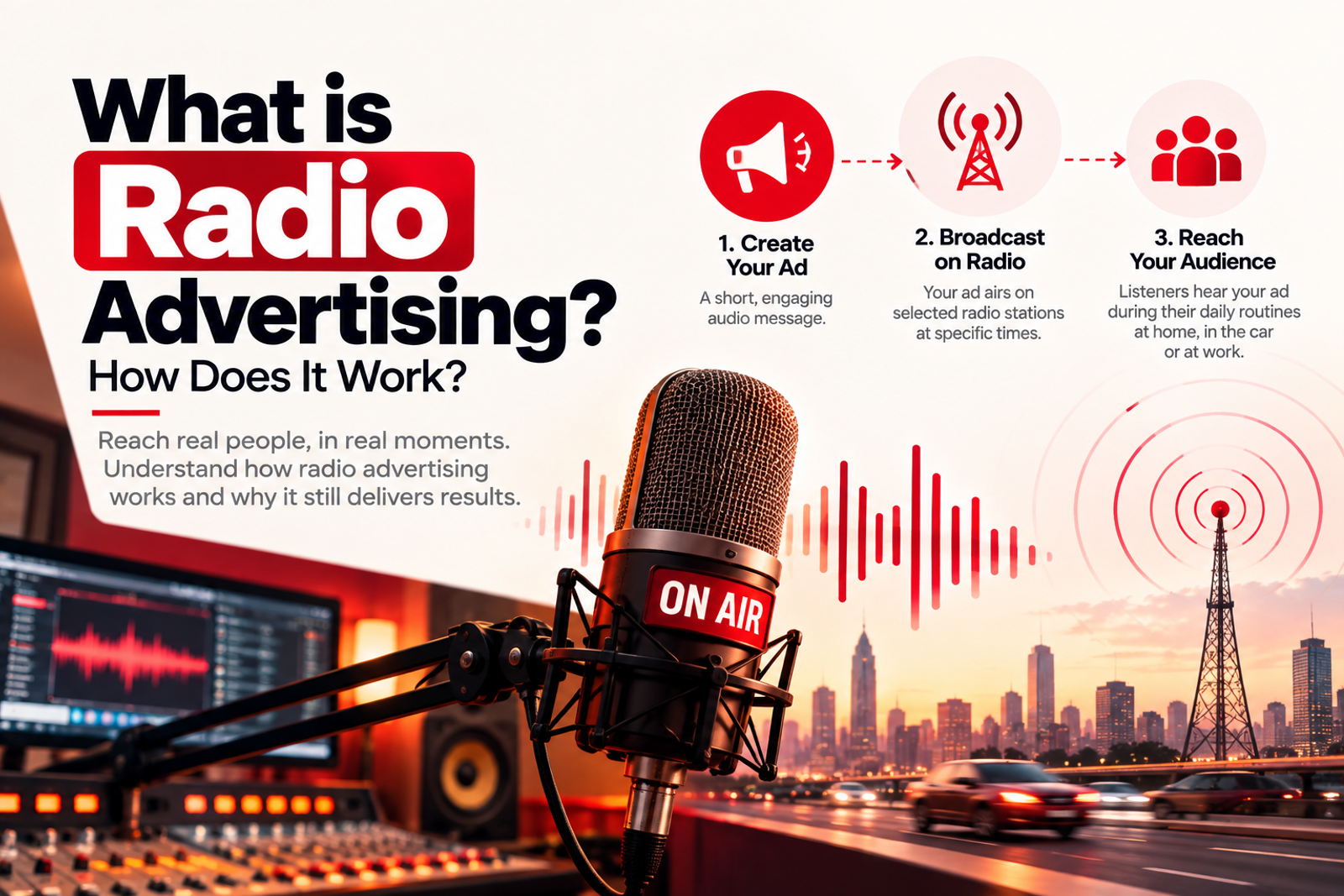
Radio advertising is paid audio communication delivered through broadcast radio, digital radio or a station's online stream. You buy access to a station's listeners in set markets and time bands. You can then run a 20-second spot, a presenter read, a sponsorship or a branded segment at an agreed frequency.
The medium looks simple from the listener's side. A 7-day Dubai campaign still needs several decisions behind the scenes. You must decide which station reaches the audience, what to say, how often to say it and how to prove the spots aired.
How a radio advertising campaign works
A campaign starts with a business objective. A retailer may want more store visits in one city. An automotive brand may need awareness across several regions. A financial service may want qualified calls from working professionals.
The media planner turns that objective into a 7-step schedule:
- Define the audience, markets, language, dates and budget.
- Compare stations by coverage area, programme profile and listener fit.
- Select the advertising format, spot length and time bands.
- Write and produce the audio in the required languages.
- Obtain brand, legal and station approvals.
- Book the airtime and release the final audio.
- Check broadcast logs and review campaign results.
The station controls its programming and commercial breaks. The advertiser buys a defined number of insertions within that schedule. Some bookings guarantee a broad time band, while others attach the brand to a programme, presenter or fixed feature.
The main radio advertising formats
| Format | How it works | Best used for |
|---|---|---|
| Recorded spot | A produced commercial plays during an ad break | Reach, repetition and controlled messaging |
| Jingle | A musical brand message builds audio recall | Consumer brands and repeated campaigns |
| Presenter read | A host delivers an approved script | Local trust and conversational offers |
| Programme sponsorship | The brand is associated with a show, segment or feature | Longer-term visibility and context |
| Time check or traffic update | The brand sponsors a recurring utility feature | Frequent, short reminders |
| Contest or listener event | A presenter invites participation around the brand | Response, launches and promotions |
A standard 30-second recorded spot gives the brand the most control. Presenter activity can sound more natural, but the script and pronunciation still need approval. A programme sponsorship on a leading station can create a stronger link with a show, though it normally needs a larger commitment.
How radio airtime is bought
Radio is usually planned by market, station, time band, duration and frequency. One Dubai station may cover the whole emirate. A network may offer 10 cities under one agreement. Public and commercial stations can follow different sales rules.
Time bands matter because listening changes through the day. Morning and evening drive periods often command a premium in commuter markets. Midday may suit retail, household or workplace audiences. Evenings and weekends can work for entertainment, dining and family activity.
The cheapest spot is not automatically the best buy. A lower rate on a weak-fit station can waste the budget. A useful comparison considers the listener profile, coverage, time band, programme environment and expected number of times the audience will hear the message.
What determines radio advertising cost?
There is no single global rate card. Cost changes by country, city, station and campaign period. These are the main variables:
- Market size and station reach
- Audience demand for the selected station
- Peak or non-peak time band
- Length of the commercial
- Number of spots per day
- Number of campaign days or weeks
- Presenter, sponsorship or activation fees
- Audio production and language versions
- Regulatory clearance, music rights and local taxes
Ask for a costed schedule, not just a price per spot. The schedule should name the station, market, dates, time band, duration and number of broadcasts. That makes competing plans easier to compare.
What makes a good radio commercial?
Radio has no screen. The script must create understanding through voice, sound and pace.
Start with the point that matters to the listener. Name the brand early. Keep one central message and one clear action. A 30-second spot cannot carry a product catalogue, a brand history and four different offers without becoming noise.
Read the script aloud before recording. Numbers, web addresses and unfamiliar names take longer to process when heard. Repeat the action if it matters. Give the voice artist a pronunciation guide for brand names, locations and technical terms.
Music and sound effects should help the message, not compete with it. If the same master idea will run in several languages, adapt the script to fit each language's natural speaking time. A literal translation often overruns the booked duration.
How many times should a radio ad run?
Radio depends on repetition. A listener may miss a spot because of a phone call, a short journey or a change of station. Several exposures help the message register.
The right frequency depends on the objective, buying window and budget. A weekend sale needs a concentrated burst close to the event. A new brand usually needs sustained activity across several weeks. A planner should balance reach, the number of different people exposed, with frequency, the number of times they are likely to hear the message.
Avoid spreading a small budget across too many stations. A focused schedule in the strongest market can produce more useful recall than occasional spots scattered across a country.
How radio advertising is measured
Measurement starts before booking. Choose a business result and a way to observe it.
Direct-response campaigns can use a dedicated phone number, short URL, landing page, promo code or store offer. Compare response by market and time period. Search and website reports can reveal branded search, direct traffic and sales during the campaign.
For awareness, use pre-campaign and post-campaign research, prompted and unprompted recall, or brand search lift. Retailers can compare store visits and sales in exposed cities with similar cities where the campaign did not run.
The station or media partner should also provide proof of execution. Broadcast logs show scheduled and aired spots. Presenter recordings, monitoring reports and activation photographs may support special formats.
Where radio works well, and where it does not
Radio is strong for local reach, frequent reminders, language-led communication and messages connected to daily routines. It can support a store opening in Sharjah, a 3-day event, an automotive launch or a university intake.
Its limits are equally clear. Listeners cannot see a pack, map or product demo. Complex terms are hard to retain. Audience data also varies between the UAE, Saudi Arabia and the United States. Radio often performs best beside search or outdoor media. Another channel can supply the visual detail or capture demand.
For an international view of market structures and language choices, read our guide to radio advertising around the world. If your brief already includes several countries, use the multi-country radio campaign planning process.
Frequently asked questions
Is FM radio the only option?
No. Depending on the market, advertisers may use FM, AM, digital audio broadcasting, satellite radio, community radio and station-owned online streams. Availability and buying rules differ by country.
Do I need a finished audio commercial before booking?
Not always. Planning and provisional availability checks can begin with a brief. The final approved file must reach the station before its material deadline. Excellent Publicity can coordinate script development, recording and language versions.
Can a small business advertise on radio?
Yes. A local business can focus on one city, one station and a few strong time bands. Clear geographic coverage and enough repetition matter more than buying a long list of stations.
What is radio advertising?
Radio advertising is paid audio communication broadcast by a radio station or inserted into its live or streamed programming. A brand selects markets, stations, time bands, spot lengths and frequency, then supplies an approved recording or presenter script for broadcast.
How long is a radio commercial?
Many radio commercials run for 10, 20, 30 or 60 seconds. The right length depends on how much the listener must understand and remember. A direct offer may fit 20 seconds, while a new product often needs 30 seconds.
How is radio advertising priced?
Pricing usually depends on the station, market, time band, spot duration, number of broadcasts and campaign dates. Production, presenter activity, sponsorships and taxes may be quoted separately.
Can radio advertising be measured?
Yes. Brands can track unique phone numbers, URLs, promo codes, search lift, app activity, store visits and sales during scheduled airtime. Broadcast logs confirm delivery, while brand studies can measure awareness and recall.